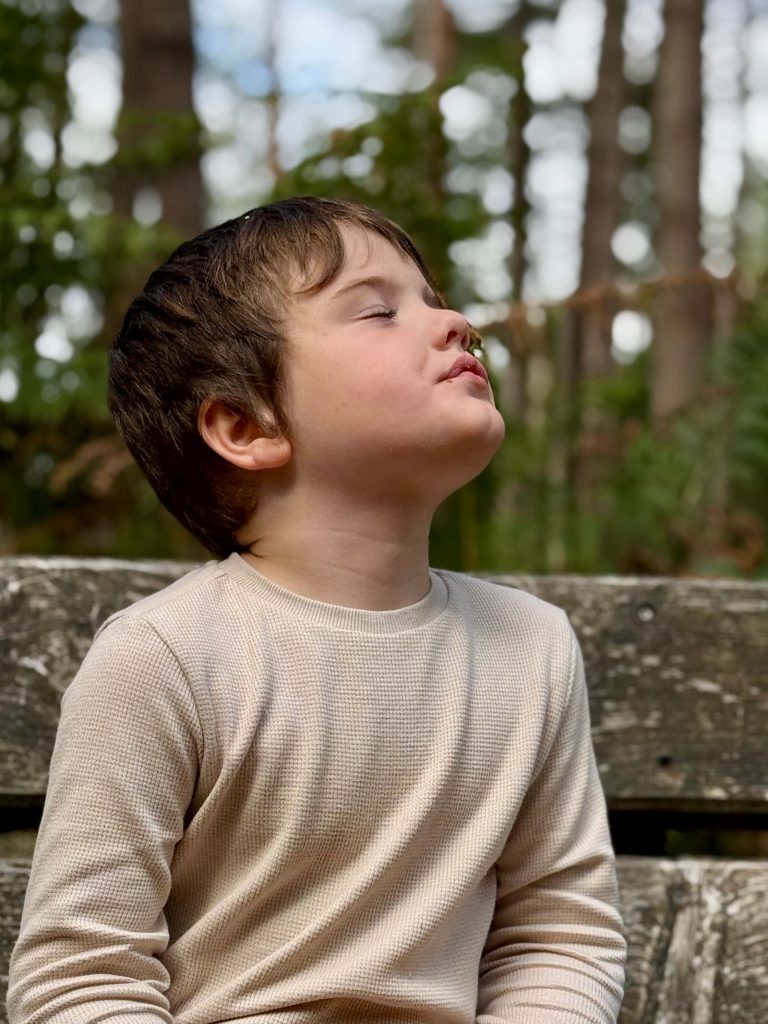

Picture this. 3 little boys aged 6 to 11, running around the woods in abysmal weather. It’s properly pouring down. They have rain jackets and wellies on but a refusal to wear a hood results in wet hair.
They’re delighted.
A handful of other children run around. Some of the parents appear somewhat miffed at standing in the rain. But most others feel the way I do. Delighted that they’re out. Relieved at how much easier it is being outside with them than stuck in an artificially lit room on a grey day trying desperately to find non screen related things to do and hoping all this excess energy doesn’t spill over into a scrap between the three of them.
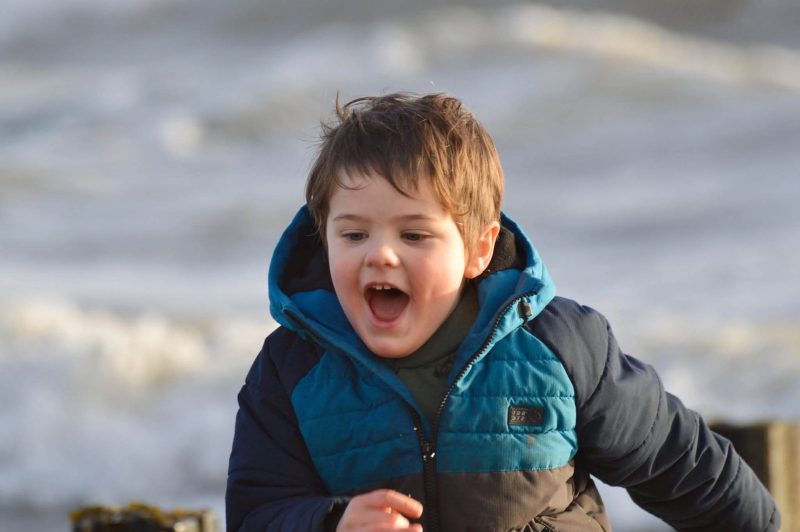
Besides, look how utterly delighted with life my youngest is the moment he’s outside:
 Three boys aged six to eleven have a lot of energy to burn, and woods, hills and puddles are far better at absorbing it than a living room. It turns out this isn’t just parental instinct. Researchers looking at outdoor time found that children who spent at least two hours outside each day clocked up 27 per cent more moderate to vigorous physical activity than children who did not. That’s not a small bump. That’s the difference between a day of proper, tired-out-by-bedtime activity and a day of low level fidgeting in front of a screen.
There’s evidence on the physical development side too. A study following eight year olds as part of the Japan Environment and Children’s Study found that outdoor play positively impacted muscle quality, particularly in boys, contributing to better physical performance. So all that scrambling over logs and hauling themselves up muddy banks isn’t just messing about. It’s genuinely doing something useful for their bodies.
Three boys aged six to eleven have a lot of energy to burn, and woods, hills and puddles are far better at absorbing it than a living room. It turns out this isn’t just parental instinct. Researchers looking at outdoor time found that children who spent at least two hours outside each day clocked up 27 per cent more moderate to vigorous physical activity than children who did not. That’s not a small bump. That’s the difference between a day of proper, tired-out-by-bedtime activity and a day of low level fidgeting in front of a screen.
There’s evidence on the physical development side too. A study following eight year olds as part of the Japan Environment and Children’s Study found that outdoor play positively impacted muscle quality, particularly in boys, contributing to better physical performance. So all that scrambling over logs and hauling themselves up muddy banks isn’t just messing about. It’s genuinely doing something useful for their bodies.
In truth, being outside is the single most important thing I believe that I give to my children. And while anecdotally I can tell you all day long how much happier they are outside, how much better behaved they are outside and how much better they sleep at night this way, there’s science behind it too.@staceyhikes The outdoors is absolutely magic… for all children (and adults), not just those with special educational needs. It’s literally life for my youngest though 🤩 #autism #autismawareness
♬ Dimensions - Arcade Fire & Owen Pallett
The physical case for going outside
Let’s start with the obvious one. Movement.Three boys aged six to eleven have a lot of energy to burn, and woods, hills and puddles are far better at absorbing it than a living room. It turns out this isn’t just parental instinct. Researchers looking at outdoor time found that children who spent at least two hours outside each day clocked up 27 per cent more moderate to vigorous physical activity than children who did not. That’s not a small bump. That’s the difference between a day of proper, tired-out-by-bedtime activity and a day of low level fidgeting in front of a screen.
There’s evidence on the physical development side too. A study following eight year olds as part of the Japan Environment and Children’s Study found that outdoor play positively impacted muscle quality, particularly in boys, contributing to better physical performance. So all that scrambling over logs and hauling themselves up muddy banks isn’t just messing about. It’s genuinely doing something useful for their bodies.
Why it’s really about mood
But if I’m honest, the physical side was never what convinced me. It’s the mood. Anyone who has tried to keep three boys entertained indoors on a wet Tuesday knows the particular kind of dread that sets in around hour two. The bickering starts. The volume creeps up. Someone always ends up in tears, usually over something that would never have registered as a problem outside. Indoors, small irritations become huge ones. Outside, they just seem to evaporate. There’s a reason for that too. A study looking at preschool children found that time spent playing outdoors was linked to better emotional regulation, and that this connection was partly explained by improvements in working memory. In plain terms, outdoor play doesn’t just tire children out, it helps them manage their feelings and cope better when things don’t go their way. Which, if you’ve got three boys, is a fairly regular occurrence. More recent research backs this up on a bigger scale. A 2025 position statement on outdoor play found it was positively associated with executive functioning, emotional regulation and stress relief in children, and that active outdoor play can actually help offset some of the negative effects of screen time on how children’s brains develop. Given how much of a battle screens can be in most households, that feels like a fairly significant point in favour of getting outside more, not less. There’s also something happening at a hormonal level. Time spent outdoors has been shown to lower cortisol, the stress hormone, along with blood pressure and heart rate, and it can improve the quality of interactions between parents and children. I notice this myself. I am a calmer, more patient parent stood in the rain in a wood than I am stuck inside trying to referee an argument over whose turn it is on the tablet. None of this really surprises me when I think about what a rainy woodland walk actually involves compared to an afternoon indoors. Outside, my boys are constantly problem solving. Which branch will hold their weight. How to get across the stream without soaking their wellies completely through, usually unsuccessfully. Where the deepest puddle is, and whether it’s worth the inevitable telling off. That’s real, unstructured play, and it’s doing far more for them than any screen based alternative ever could.Why the weather doesn’t actually matter
Which brings me to weather. I think this is where a lot of parents get it wrong, myself included in my more tired moments. There’s a tendency to treat good weather as a prerequisite for a good day outside, and bad weather as a reason to stay in. In my experience, it’s almost the opposite. A grey, wet day removes the temptation to sit still. Nobody wants to stop and admire the view when it’s chucking it down, so instead the children move, they build, they splash, they invent games to keep themselves warm. Bad weather forces a kind of play that fair weather doesn’t always demand. Sunny days can end up being spent lying on a picnic blanket. Wet days rarely do. That’s not to say I don’t love a sunny walk. Of course I do. But I’ve stopped seeing rain as a reason to cancel plans, and started seeing it as, if anything, a bit of an advantage. Wet hair and all.A few practical tips
So if you’re a parent standing at the back door wondering whether it’s worth getting three sets of waterproofs on for the sake of forty minutes outside, here’s what I’d say based on both the research and rather a lot of personal trial and error.- Get the kit sorted properly and weather stops being the obstacle it seems. Good waterproofs and decent wellies do more to make outdoor time enjoyable than good weather ever will. It’s far easier to love being outside when you’re not also cold and soaked through.
- Start small and local. You don’t need a mountain. A local wood, a park, even a scrubby patch of green space near home is enough to get the benefits going. The distance matters far less than the frequency.
- Let them lead a bit. Some of the happiest outdoor moments with my boys have come from letting them choose the direction, the pace, and the detours, rather than marching them along a route I had planned. Half the value seems to come from the sense of freedom itself.
- Build up their tolerance gradually. If your children aren’t used to being outside in poor weather, the first few times might be a bit of a battle. Stick with it. It gets easier, and so does their attitude towards it.
- Don’t wait for the perfect day. It won’t come, or if it does, you’ll have missed half the year waiting for it.
The whole argument, really
Standing in the rain isn’t every parent’s idea of fun. But I’ll take a soggy, delighted six year old over a dry, bored one every single time. My boys sleep better on the nights we’ve been out in the wet than on the nights we’ve been stuck inside, and honestly, so do I. That, in the end, is really the whole argument. It’s not always comfortable. It’s rarely convenient. But it works, and there’s a growing pile of research quietly agreeing with what any parent who’s tried it already knows.Sources
- UNICEF Europe and Central Asia, “The importance of outdoor play (and how to support it)” — citing research on outdoor time and moderate-to-vigorous physical activity in children.
- Yamanashi Adjunct Study, Japan Environment and Children’s Study — “Effects of outdoor play on body composition and physical performance in children,” published via PMC/NCBI.
- “The Role of Timing and Amount of Outdoor Play in Emotional Dysregulation in Preschool Children,” Child: Care, Health and Development, 2024, published via PMC.
- Parent Herald, “Why Outdoor Play Is Critical for Children’s Physical and Mental Health,” referencing a 2025 position statement on outdoor play, executive functioning and screen time.
- Healthline, “Outdoor Play: Mental Health Benefits, How to Tips, and More” citing research on cortisol, blood pressure and parent-child relationship quality linked to outdoor time.